
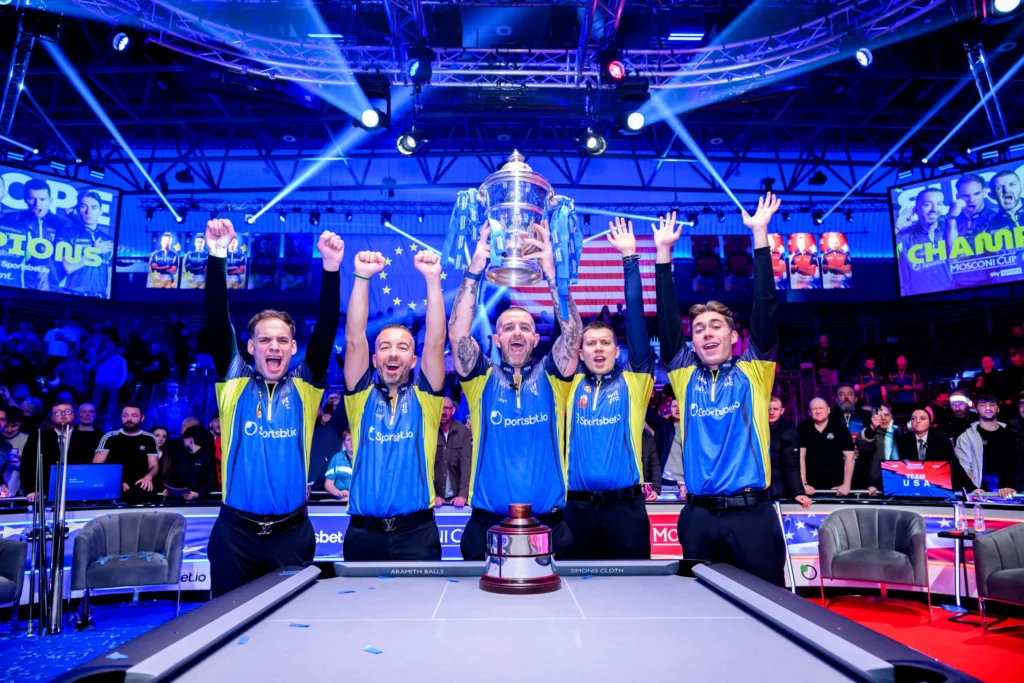
The Mosconi Cup has always lived in that strange space between sport and spectacle, part golf, part boxing match, and part Las Vegas residency show. And in a way, that’s what makes it fun. But this year’s result, an 11–3 win for Europe, raised a different kind of conversation. Not about who’s better on paper, but about why a team featuring two of the world’s very best players, Shane Van Boening and Fedor Gorst, still looked like they were walking into the arena as visitors, while Europe marched in like favored gladiators.
And to be clear, this isn’t a hand wringing, “poor Team USA” piece. They’re big boys. They signed up for the chaos. But let’s talk seriously about the competition, the environment, and whether the event should evolve. To do that, we have to look at the whole picture.
The Arena and the Visitors
The location swaps every year. Europe hosts one year and the United States hosts the next, so you’d think home field advantage would balance out. But the fan culture doesn’t swap as evenly. European fans treat the Mosconi Cup like a football match. They’re loud, proud, and absolutely unashamed to let the opposing team know it.
To their credit, it’s passion. It’s energy. It’s fun.
But when that energy turns into jeering during a player’s final shot (and it happened multiple times this year) it stops being “atmosphere” and starts affecting outcomes. Several U.S. players missed routine closers under sudden bursts of noise. Not miscues, not heroic collapses, just simple shots missed because someone in the crowd decided they wanted to be part of the moment.
American crowds, even when fired up, tend to quiet down when the player gets down on the shot. European crowds… not so much. And while that rowdiness is part of the event’s charm, we should at least be honest about the impact it has.
Tight Pockets and Thin Margins
Four inch pockets already turn the table into a small minefield. These aren’t league night conditions where you can cheat an inch of rail and still pot the ball. Under TV lights, with adrenaline running hot, even elite players see their percentages drop.
Add sudden noise during the final stroke, and you’re not testing skill anymore. You are testing a player’s ability to ignore intentional disruption.
Snooker doesn’t allow that. Golf doesn’t allow that. Even darts, one of the loudest sports on the planet, goes quiet on the throw.
Pool sits in a weird middle ground. It wants the hype, and it deserves it, but it also relies on fine motor execution that simply doesn’t mesh with random outbursts.
Preparation: A Tale of Two Philosophies
Here’s where the structural differences become hard to ignore.
Europe doesn’t just show up to the Mosconi Cup; they move into it. In the run-up to this year’s event, Jayson Shaw brought his team to Scotland, put them together in a big house in the countryside, and spent days mixing hard practice with hanging out, joking around, and living like a unit. That kind of time matters. By the time they step into the arena, they aren’t just five great players, they are one group with a shared rhythm.
Team USA’s approach is different. Players qualify through WNT event points, plus a couple of captain’s picks. That is fair for selecting talent, but it does not automatically build cohesion or trust. Some years it feels like the players arrive from five separate tour schedules, squeeze in a short camp, and then are expected to instantly operate as a tight squad. There are even hints that not everyone is eager to grind together in practice the way the Europeans do.
And chemistry matters. When the pressure hits, and it always does, you want a team that feels like a team, not an assortment of highly skilled freelancers who just happen to be wearing the same shirt.
So What Do We Want This Event to Be?
If the Mosconi Cup is meant to be a pure test of team pool, then we may need clearer lines around crowd behavior. Not library silence, just a simple expectation that when a player is down on the shot, fans hold their tongue for five seconds.
If the event is meant to be a pressure cooker, the gladiator pit we all secretly enjoy, then let’s acknowledge that too. But we shouldn’t pretend sudden jeers don’t influence the match. They do. Every sport with precision execution knows this–pool shouldn’t be the exception.
The solution isn’t turning the event into church. It’s just about drawing a line between energy and interference.
The Crossroads
There’s no question Europe earned the win this year. They played better, handled the chaos better, and embraced the moment. But if we want the Mosconi Cup to stay competitive and compelling, then both sides may need to look at what they’re bringing to the arena.
Team USA has to build a real program, not just assemble the five hottest names. Fans, especially in Europe, can stay rowdy, just not during the swing. And the event organizers might consider deciding what the Mosconi Cup wants to be in the long term: a sport, a show, or something in between.
Right now it feels like Europe walks in fully settled, the U.S. is still trying to find its footing, and the crowd is doing everything it can to tilt the moment. It makes for great theater, but it also raises real questions about what kind of contest we want this to be.
What are your thoughts?
I’ve got my own take, but I’m just one voice in a very loud room. As fans, players, and people who care about cue sports, what do you think? Is the Mosconi Cup better as a wild, noisy pressure cooker, or should there be clearer lines between passion and interference? I’d love to hear your thoughts and experiences, so leave a comment and let’s keep the debate going.


Leave a Reply